|
|
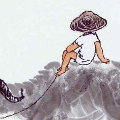
(About Chinese Painting)
This brief desciption of chinese painting is found in the website of the National Palace Museum of Taibei. Guren Banzhu posted it at the Calligraphy and Painting. The original text was written in classic Chinese and I found the English translation is easier (though it has omitted some contents near the end).
我法可概分楣すP和意深,家作,v究以神S形。
Chinese painting can be divided into two major modes; a meticulous and detailed one (kung-pi) and a free, expressionistic one called "sketching ideas (hsieh-i)." A middle path, however, is often adopted to avoid extremes and capture accurately the outer form as well as the inner spirit.
描L精微者,不拘泥於眼中所; S意]⒄擼膊蝗渾x真背。景布局重在引^p者如R真境,得天人合一之趣。
The traditional artist may paint with great detail, but would not just copy exterior forms; or, the artist may paint with abandon and set aside the rules of representation, but not go so far as to create abstract art. Whether a vast overview or an intimate scene, the goal of the artist is to lead viewers into a painting and create a realm unto itself.
而鱒,皆以毛P楣ぞ擼率一w。又或之不足}以文,或文以楫,甚上m未}一字也M得趣。c⒃Y合成一w,加上j印,使中在形式上和表F精神上,卓立於世界。
Furthermore, the Chinese (writing with the brush) naturally transfer the techniques of calligraphy to painting. As sister arts, they often appear together. When combined with poetry and the seal, the work is complete in form and spirit to create one of the enduring features of Chinese painting.
(Translation: Elaine Tann)
Source: National Palace Museum 故宮博物院 |
|


 狗仔卡
狗仔卡


 匾額釋文: 簌情齋
 提升卡
提升卡 置頂卡
置頂卡 沉默卡
沉默卡 喧囂卡
喧囂卡 變色卡
變色卡 搶沙發
搶沙發